BurgCRM, the CRM we built for ourselves
BurgCRM is a complete CRM for small Dutch businesses: contacts, deals, quotes, invoices, email marketing, tickets and appointments in one application. We designed and built it ourselves, in PHP without a framework, and it runs on ordinary shared hosting. Every request sent through this website lands in it.
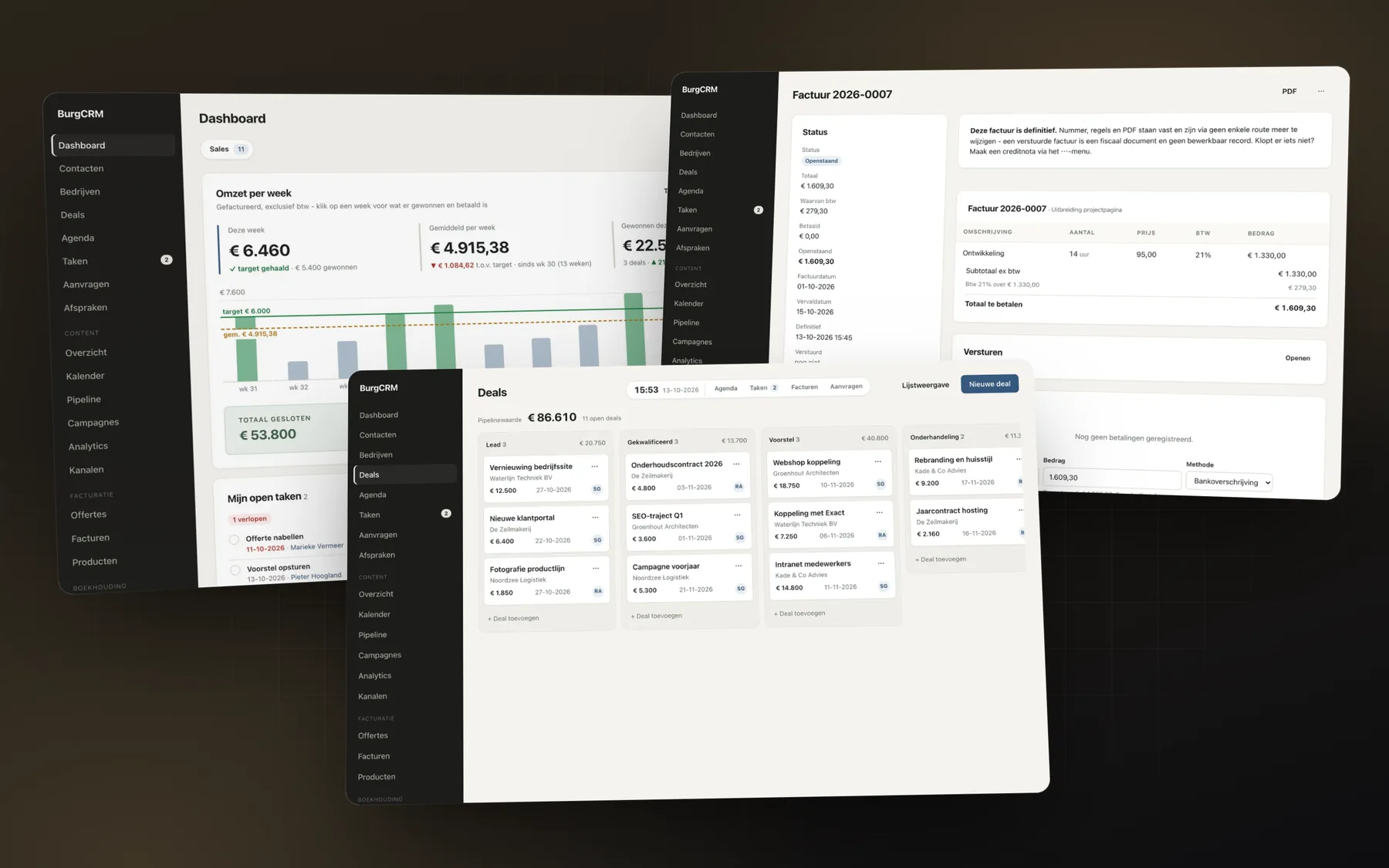
Why we built our own CRM
We wanted one place for everything to do with clients: the request that comes in, the conversation, the quote, the invoice and the payment. The well-known packages can do that, but you pay per user per month, you never touch half of the features, and Dutch invoicing with reverse-charge VAT or an invoice to a Belgian client often means another subscription on top.
So we built it ourselves, with one hard requirement: it had to run on the kind of hosting a small business already has. No server to maintain, and no third-party services looking over your shoulder with every click.
Burg Media now runs on it. The request form on this website is a BurgCRM form, and the invoice you get from us comes out of it.
What is in it
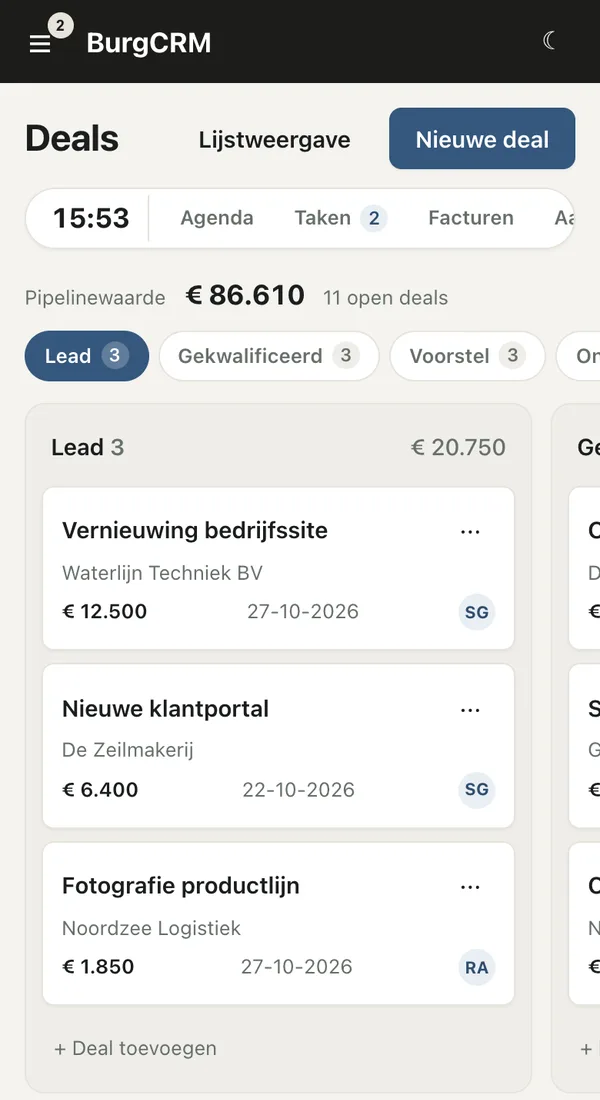
Everything in one application, in Dutch, with a dark mode and a layout that also works on a phone.
Sales
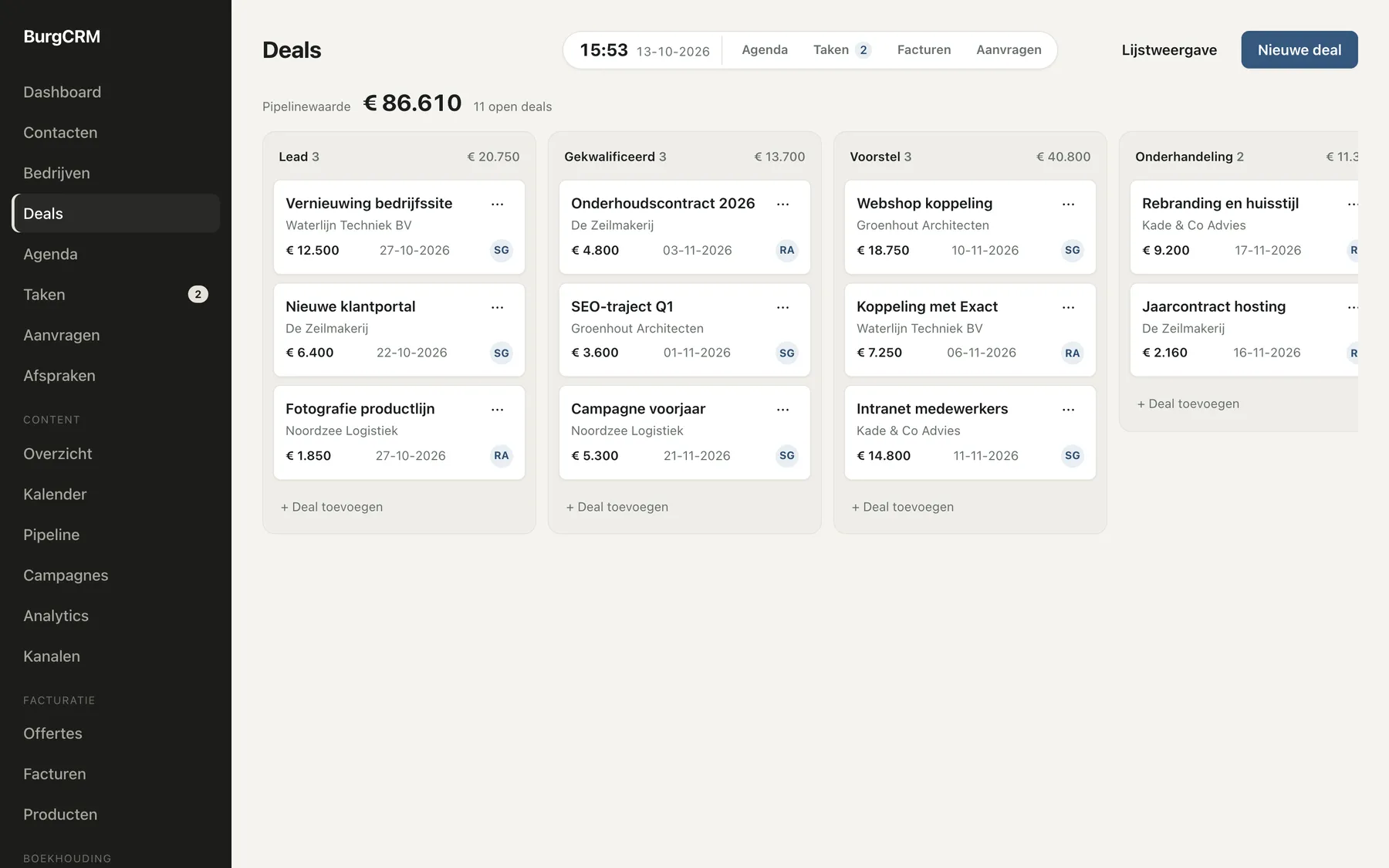
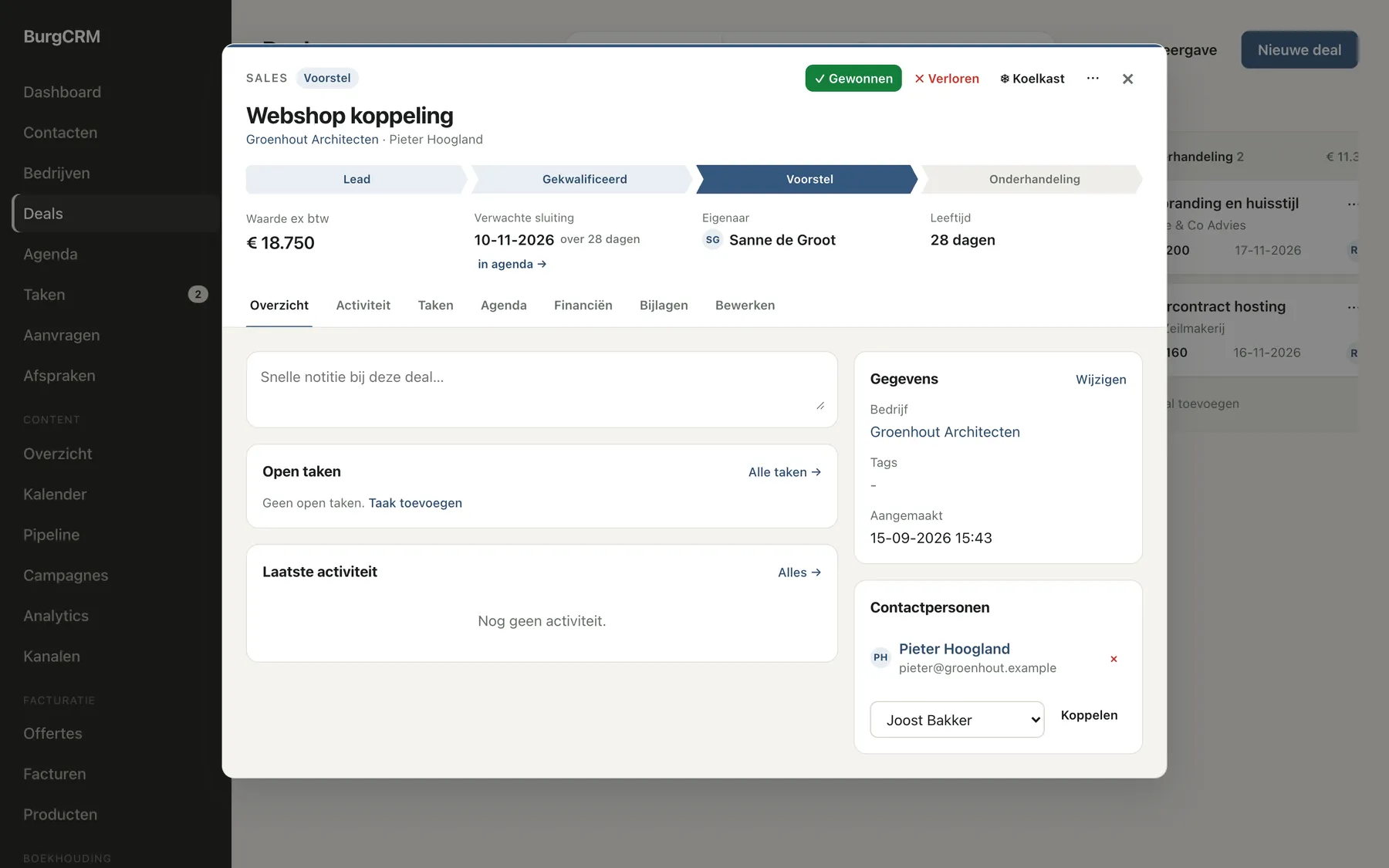
Contacts and companies, with a Chamber of Commerce (KVK) lookup that fills in the name and address. Deals on a kanban board with your own pipelines and stages. A deal that is on hold goes into the fridge, so it does not clutter the board and does not get lost either. Lead scoring with rules you set yourself.
Quotes and invoices
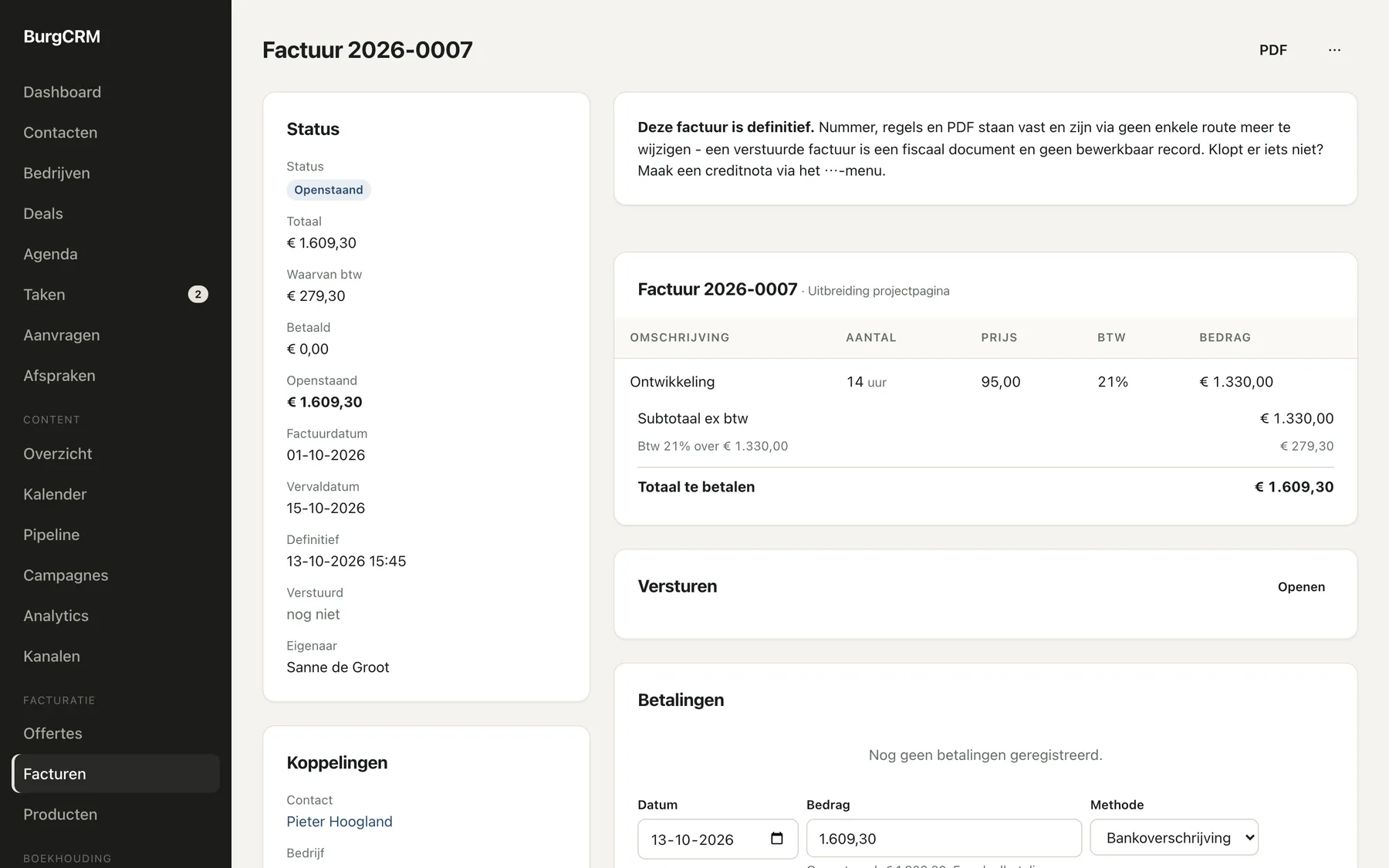
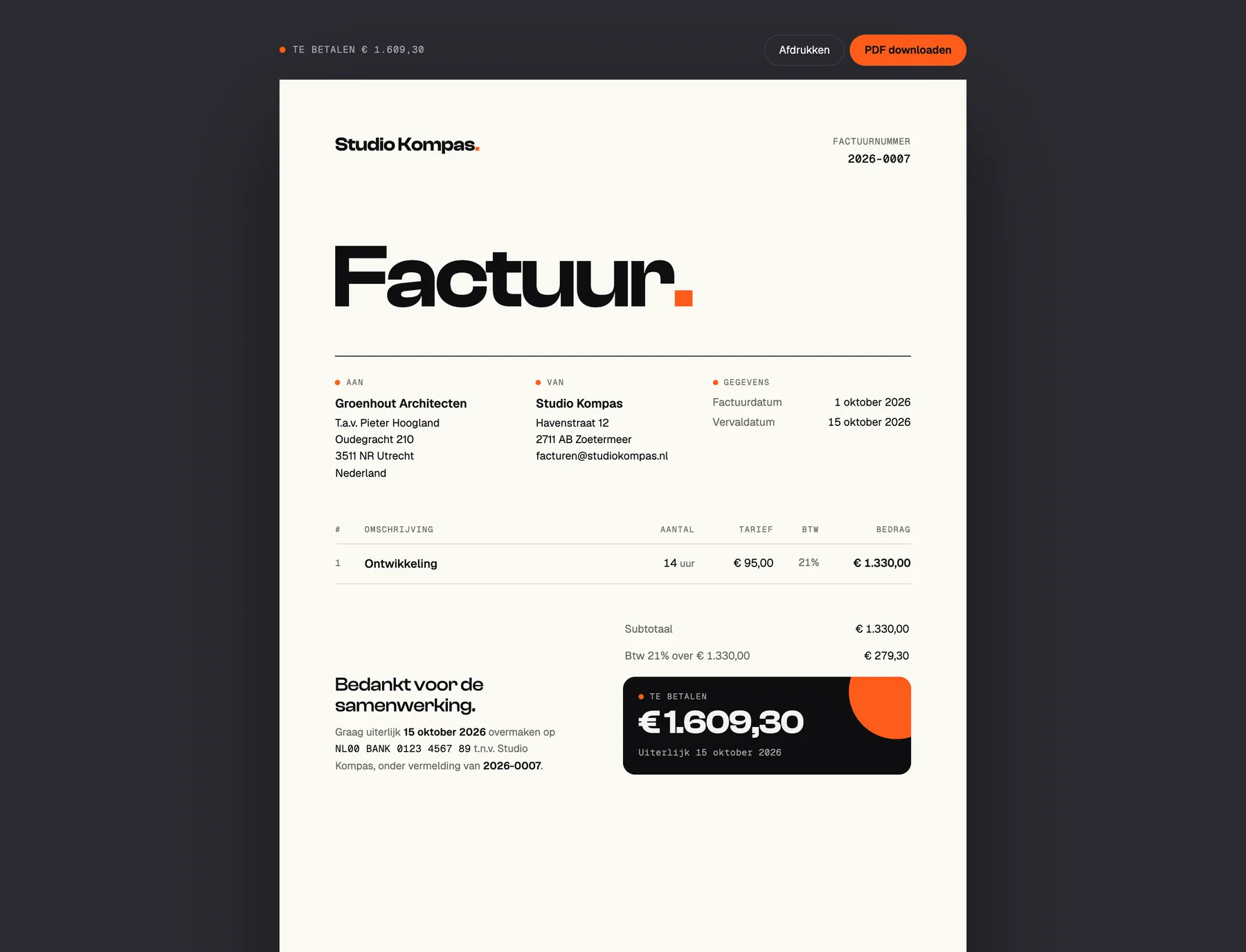
Quotes with versions and an online page where the client accepts or declines. Invoices and credit notes that follow Dutch VAT rules, including reverse charge, supply within the EU and export outside it. You register payments, reminders go out on their own, and invoices are kept for seven years. The client gets a link to an online invoice with a PDF.
Marketing
Forms you place on any website with one line of code. Newsletters with one-click unsubscribe, campaigns to a segment with open and click tracking, and follow-up emails that go out on a schedule. A suppression list that every email respects.
Service
Tickets with a conversation per client, a public knowledge base, and booking pages with availability, buffers between appointments and calendar invitations.
Content and bookkeeping
A content planner that publishes blog posts to our CMS and posts to Facebook and Instagram, with figures from Search Console and Analytics. And for a sole trader: expenses with receipts and the VAT return. Receipts are read in the browser itself, so not a single receipt goes to an outside text recognition service.
How it is built
No framework, but fixed rules
BurgCRM has no runtime dependencies: you unzip a folder, point a domain at it and it runs. On shared hosting every dependency is a reason for it not to work: a PHP version that is just too old, an extension that is missing. Routing, templates, validation and the queue are our own code, about 1,500 lines, all of it tested.
For client projects we usually do pick Laravel. For a product that someone else installs on their own hosting, every dependency weighs more.
Money is never a decimal fraction
In PHP, 0.1 + 0.2 is not 0.3. On an invoice that adds up to a difference of a cent, and then the client is right. So BurgCRM calculates in whole numbers: amounts in cents, quantities in thousandths, unit prices in ten-thousandths. VAT is calculated per rate over the total of the lines, not per line, because rounding per line and adding it up is structurally off by a cent.
Invoice numbers without gaps
A gap or a duplicate number in your invoice sequence is a problem with the tax authorities. That is why a draft has no number yet. The number is drawn at the moment the invoice becomes final, in the same database transaction, with the sequence locked. If anything fails, including generating the PDF, the number rolls back with it.
We found a real bug here. Six simultaneous requests caused five deadlocks, because of the order of two queries. We swapped them, and since then a test with real separate processes proves that the numbering holds under load.
One way out for all email
Every email BurgCRM sends goes through one function. That is where the suppression list is checked, the unsubscribe header is set and the email is added to the contact’s timeline. So a new kind of email can never accidentally reach someone who has unsubscribed. Bulk email goes through a queue, so a campaign to ten thousand addresses runs out over a few hours instead of timing out.
A cron job that never does anything twice
One task per minute handles all background work: reminders, payment reminders, campaigns, workflows. Every step can run twice without sending anything twice, because a cron job that runs every minute will run twice at some point too. On shared hosting it is the only way of doing background work that works everywhere.
Integrations without an SDK
Google Search Console and Analytics, Meta for Facebook and Instagram, and our own CMS are connected without extra packages. For Google, BurgCRM signs its own access token (a JWT). Tokens are stored encrypted in the database. If a connection breaks, you see it before a post fails.
Secure by default
All SQL through prepared statements, all template output escaped, CSRF protection on every form, a Content Security Policy per request and security headers on every response. No CDN: the scripts live on your own server, so your client’s browser talks to nobody else.
Every organisation its own database
Every installation has its own database. Data from different businesses is never mixed, a problem at one never affects another, and anyone who wants to leave takes their complete database with them.
After installing
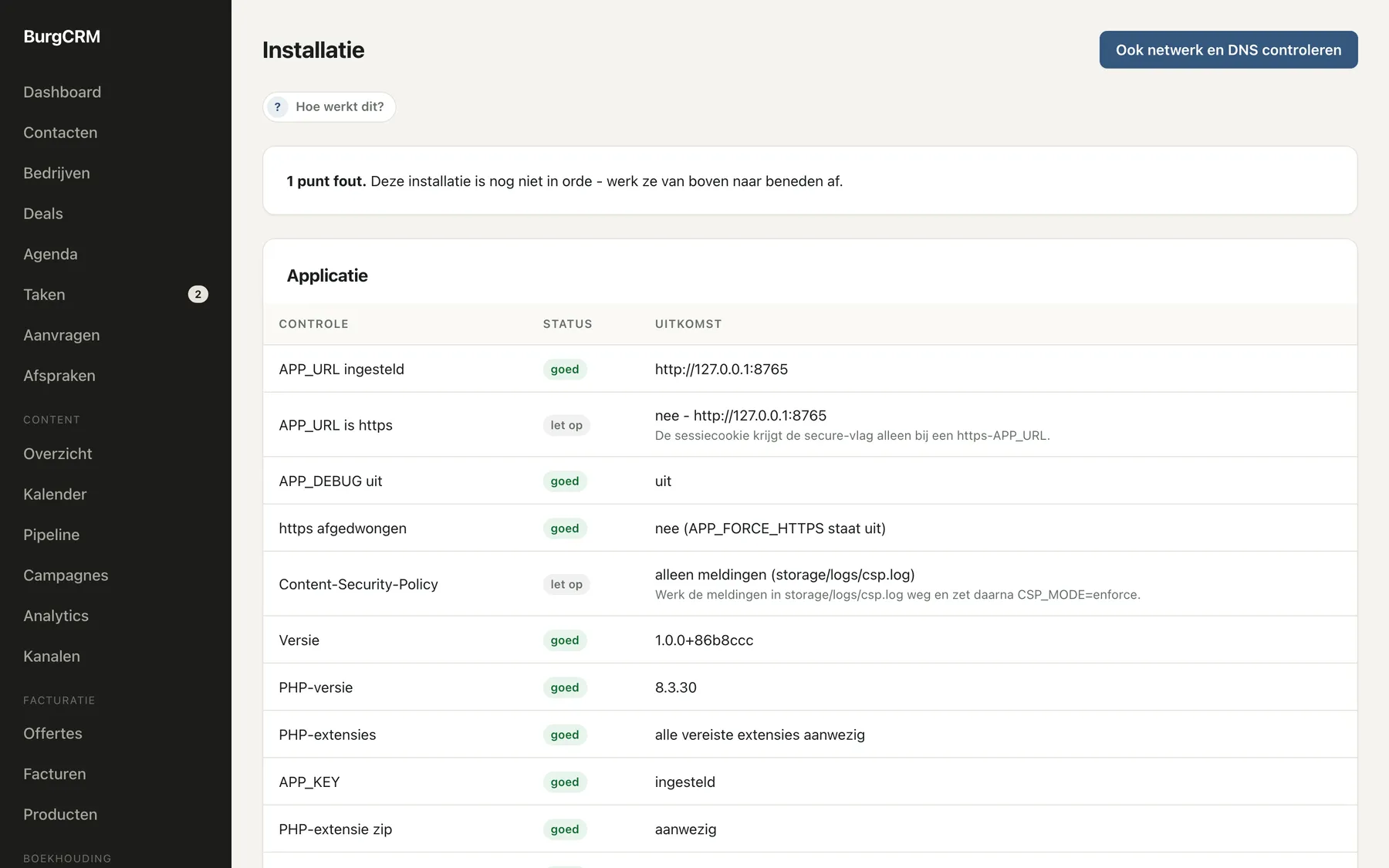
After an installation you run one check. It looks at the configuration, the database, file permissions, whether the cron job is running, and whether SPF, DKIM and DMARC are set up for your sending domain. The same check is in the app under Beheer (admin).
What this means for you
BurgCRM is our own product, but it is built the way we build every custom application. If you have a process that now lives in Excel, email and separate packages, these are the building blocks we bring: calculations that are right to the cent, numbering and documents that hold up for the tax authorities, email that gets delivered, and software that runs on ordinary hosting.